 Μake us preferred on Google
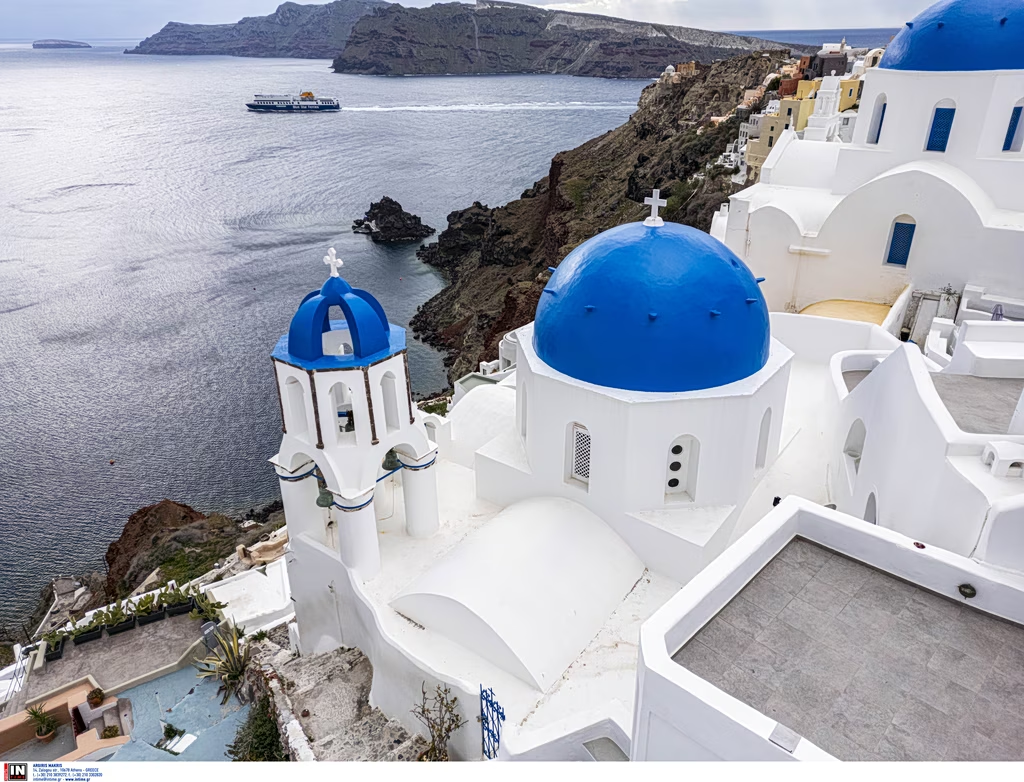
A 500-meter fiber-optic cable is being transformed into an underwater monitoring system designed to detect volcanic and hydrothermal activity off the Greek islands of Santorini and Milos.
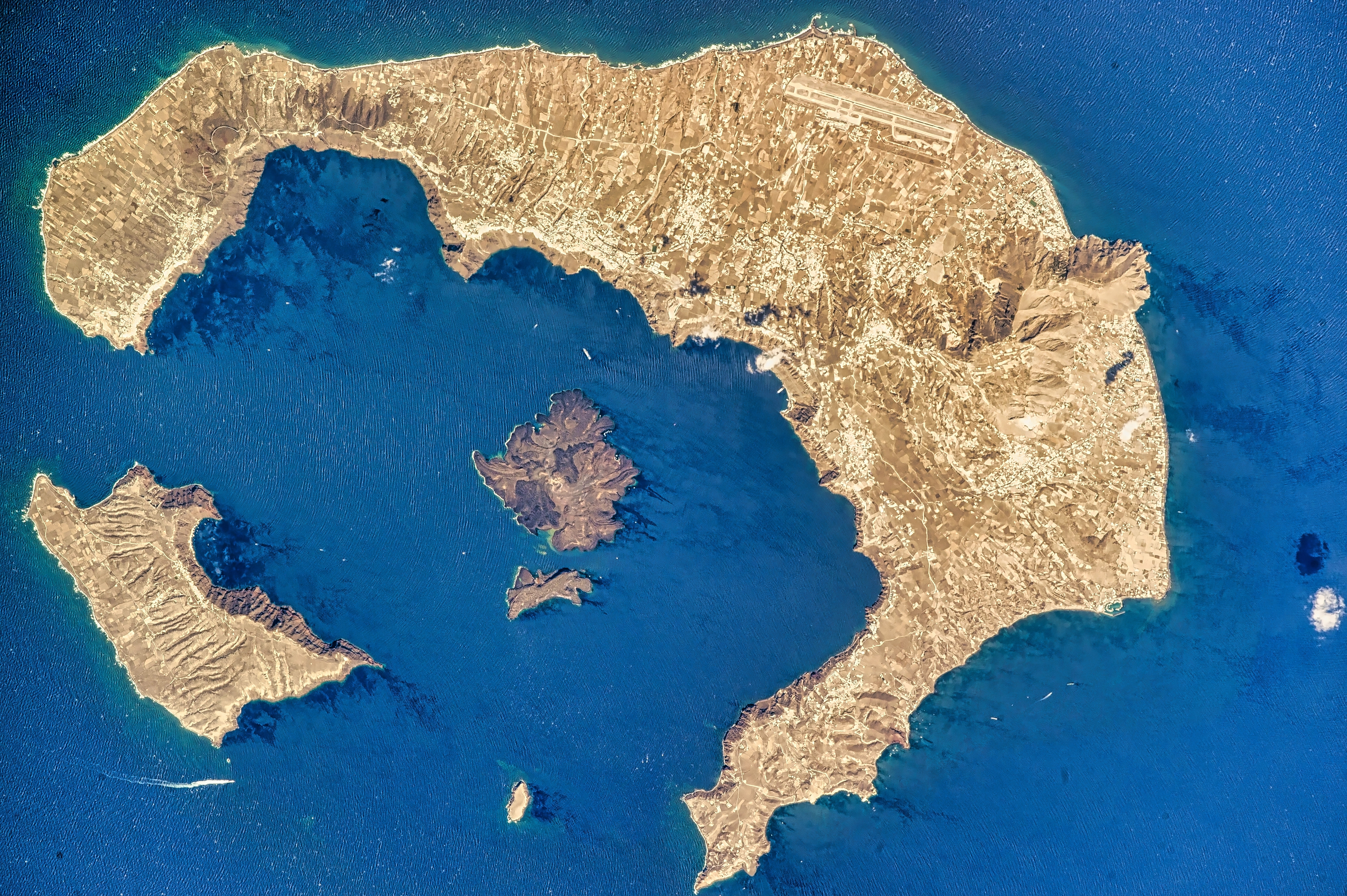
The cable is being deployed inside the underwater crater of Kolumbo, northeast of Santorini, as part of the oceanographic mission “HYDROSENSE.” Researchers are using fiber-optic technology to record faint vibrations and acoustic signals that could reveal processes beneath the seafloor that have so far been difficult to detect.
The project brings together scientists from the Laboratory of Physical Geography at the National and Kapodistrian University of Athens (NKUA), the U.S.-based Monterey Bay Aquarium Research Institute (MBARI) and the Italian National Research Council (CNR). The work is being carried out aboard the CNR research vessel Gaia Blu.
Why researchers chose the Kolumbo crater
The underwater volcano is a particularly important site for monitoring geological hazards and testing new technologies.
In early 2025, the area experienced an intense volcanic and tectonic crisis lasting approximately one month. Seismic activity quickly shifted northeast of Kolumbo toward the islet of Anydros, and more than 30,000 earthquakes were recorded.
The episode highlighted the need to strengthen underwater monitoring infrastructure. Although research in the area has advanced, scientists still face significant gaps in their understanding. Land-based seismic networks cannot detect every weak acoustic signal associated with bursts of microseismic activity, while knowledge of the underwater pathways through which hot fluids and gases escape remains limited.
How the fiber-optic cable listens to the seafloor
The HYDROSENSE mission uses Distributed Acoustic Sensing (DAS), a technology that turns a fiber-optic cable into an extensive network of sensors.
The system sends laser pulses through the fiber and measures tiny changes in the light reflected back. These changes allow it to detect vibrations and acoustic disturbances at hundreds of points along the cable, effectively creating an underwater sensor array.
One of the experiment’s central aims is to determine whether the sound produced by gas bubbles escaping from the seafloor can reveal how much gas is being released and how emissions change over time.
To assess the measurements, researchers are also using other instruments, including an underwater stereoscopic camera, temperature sensors and a hydrophone, which records sounds generated by the escaping gas.
The team is examining whether it can distinguish the acoustic signals and vibrations caused by bubbles from other underwater noise, and whether the system can track changes in gas emissions.
The findings could improve understanding of hydrothermal and volcanic systems and help pave the way for early-warning technologies. The cable will be retrieved once the mission is complete. If the method proves effective, it could eventually be used to monitor large underwater areas continuously.
First tested in Milos
Before its deployment at Kolumbo, the technology was tested off Milos, an island with one of the world’s largest known shallow submarine geothermal systems.
There, seawater seeps into permeable sediments and fractured rocks, heats up underground and rises back to the seafloor, carrying dissolved chemicals and gases.
Aaron Micallef, principal investigator at MBARI’s Seafloor Processes Lab, told the Athens-Macedonian News Agency (AMNA) that the hydrothermal vents are located in shallow water close to shore. This allowed the research team to install the laser-based detection system at a protected site on land.
With the help of local divers, researchers laid approximately 500 meters of cable on the seabed near known gas-emission sites, allowing them to better control the conditions of the experiment.
The team also used an autonomous underwater vehicle, the “MOLA AUV,” developed by MBARI’s CoMPAS Lab. The robot produced high-resolution, three-dimensional maps of the seafloor, documenting hydrothermal structures, gas emissions, bacterial mats and mineral deposits.
A more challenging deployment at Kolumbo
Applying the technology at Kolumbo is considerably more difficult than the initial test in Milos. Hydrothermal activity takes place within an active submarine volcanic system shaped by interactions among magmatic processes, fault movements and fluid circulation.
Micallef described the site as a different and particularly interesting scientific challenge. Researchers plan to deploy approximately 500 meters of cable from the research vessel inside the volcanic crater, at depths approaching 500 meters.
Unlike in Milos, divers cannot assist with the installation. The steep and complex volcanic terrain also makes it harder to position the cable accurately. The team will therefore use a specialized deployment system, supported by underwater observations from a remotely operated vehicle (MiniROV).
The MiniROV is equipped with advanced sensors developed by MBARI’s CoMPAS Lab. These will allow researchers to map geological structures and hydrothermal features in three dimensions and at high resolution.
A scientific leap for underwater volcanology
Evi Nomikou, professor of geological oceanography at NKUA, described the introduction of DAS technology at Kolumbo and the hydrothermal field off Milos as “a real scientific leap for underwater volcanology and oceanography in the Aegean.”
Turning a fiber-optic cable into a dense network of thousands of virtual sensors will allow scientists to record processes more accurately, including phenomena that land-based seismic networks struggle to detect, she said. She also highlighted the importance of cooperation with MBARI in bringing advanced technology and expertise to the southern Aegean.
Nomikou said the seismic and volcanic crisis of early 2025 demonstrated the need for uninterrupted underwater monitoring. Deploying the cable inside the crater and connecting it to the Geo-Sense system will make it possible to record underwater seismic tremor, bursts of microseismic activity and the geometry of fluid pathways. It will also allow researchers to study how hydrothermal activity relates to microbial communities on the seafloor.
According to Cyclades 24, Nomikou has also identified the reinstallation of all instruments belonging to the SANTORY underwater volcanic observatory at Kolumbo as a priority. She said this would require state funding and support from the Municipality of Thira, which administers Santorini.
Continuous monitoring of the seafloor cannot depend solely on periodic research projects, she stressed. It requires stable institutional and financial support to help protect Santorini and the southern Aegean.